Galactic
Terminal workbench for operators who think in structured output.
What it is
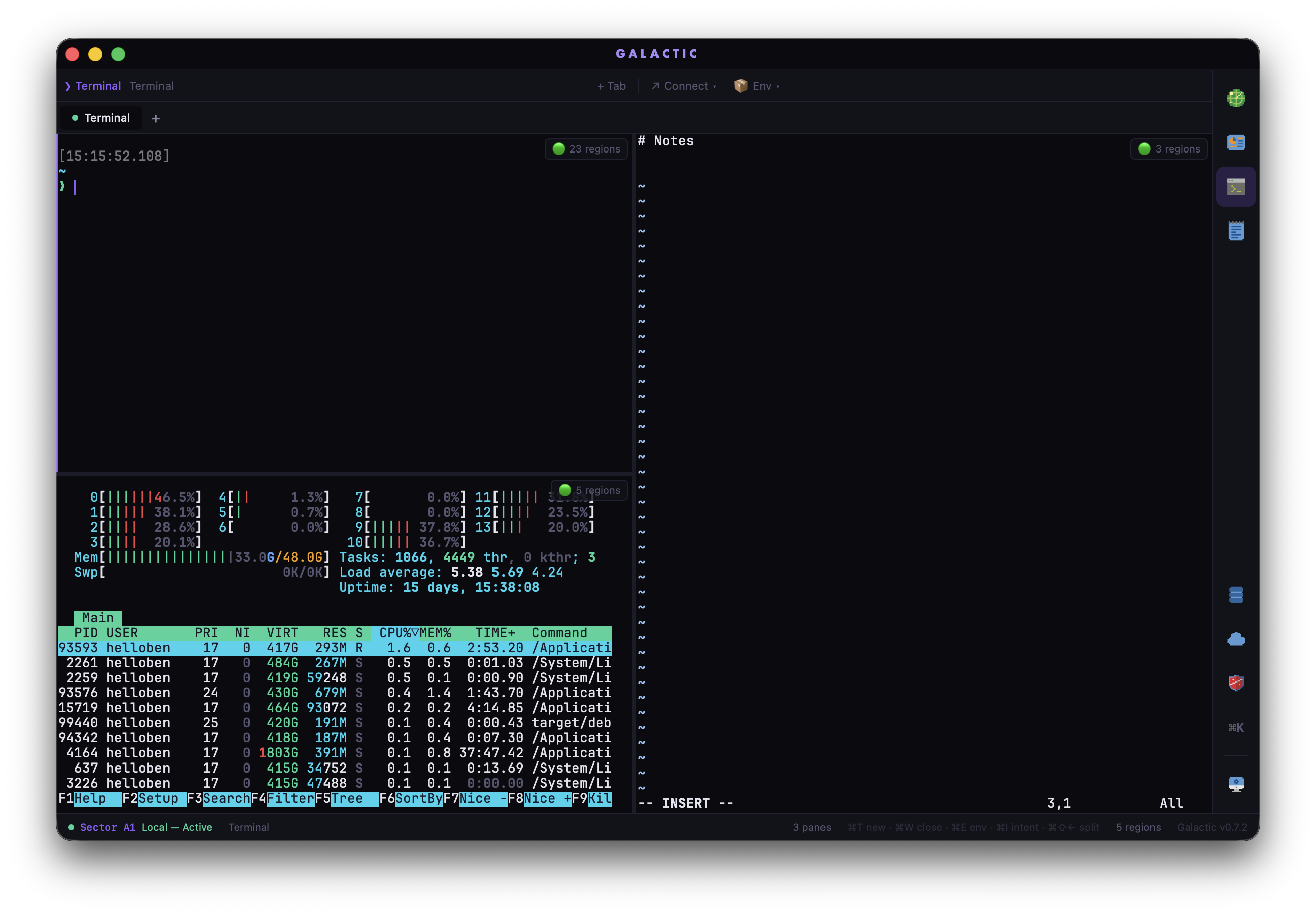
Galactic is a terminal workbench designed for infrastructure operators. Not a terminal emulator — a terminal workbench. It combines PTY management with structured output regions, pass/fail badges, foldable command results, and persistent state. Think of it as what happens when someone who deploys OpenStack clusters all day gets fed up with tabbing between sixteen terminal windows.
Why it exists
Terminal emulators are generic by design. They don’t know that the command you just ran was a deployment, that it succeeded, or that the output has three distinct sections you’ll want to reference later. Galactic understands operational workflows and presents terminal output as structured, navigable information instead of an infinite scroll buffer.
What makes it different
Structured output regions. Command results are parsed into collapsible, labeled sections. Deployment output isn’t a wall of text — it’s a foldable document with pass/fail indicators.
Operator’s cockpit. Purpose-built for the workflow of deploying, debugging, and monitoring infrastructure. Multiple hosts, multiple sessions, one coherent view.
Built on nominal-term. Uses the reusable terminal engine from the Nominal SDKs, with a ghostty-web WASM VT100 parser under the hood. Fast, correct terminal rendering without reinventing the wheel.
Persistent state. Your session layout, command history, and output regions survive restarts. Because “let me re-run that command from yesterday” shouldn’t require archaeology.
The name
Infrastructure at scale feels like managing a galaxy — thousands of nodes, services, and connections, all in motion. Galactic is the cockpit for navigating it.